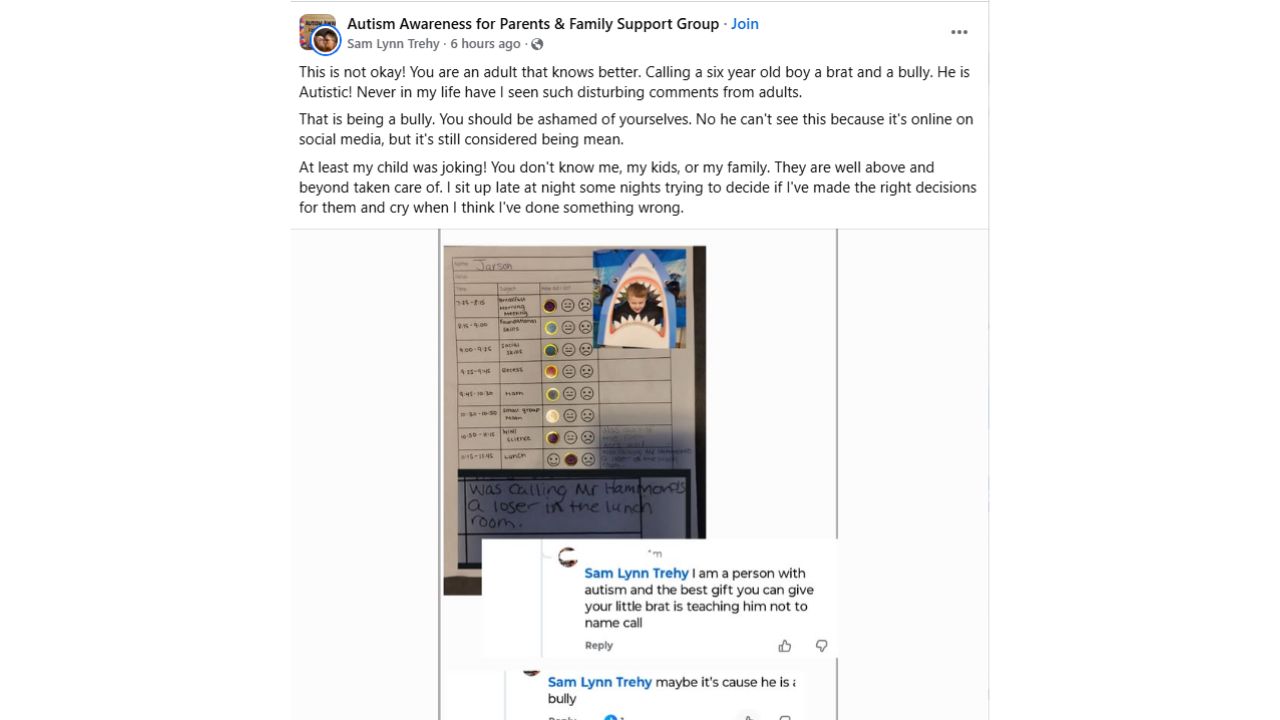
A heated debate has unfolded inside a Facebook parenting community after a mother defended her six-year-old autistic son from harsh criticism by other adults in the group.
What began as a discussion about a child’s behavior quickly escalated into a broader argument about autism, discipline, and where empathy should meet accountability.
The original post, shared by Sam Lynn Trehy in an autism support group, expressed outrage over adults calling her young son a “brat” and a “bully.”
She emphasized that her child is autistic and insisted the comments crossed a line. According to her, the situation was being taken out of context, and her son had been joking rather than intentionally trying to hurt anyone.
Trehy also opened up about the emotional weight of parenting, saying she often spends sleepless nights questioning her decisions and worrying about whether she is doing the right thing for her children.
Her post struck a chord with some members, but it also drew sharp criticism from others who felt the issue was less about autism and more about behavior.
Divided Opinions on Discipline and Understanding
Many commenters argued that while autism requires understanding, it should not excuse hurtful behavior. Several parents shared their own experiences raising autistic children, emphasizing the importance of teaching kindness and boundaries.
“Autism or not, you can and should still teach your child right from wrong,”
PrettyMama1234
Natasha van Gils-Guttery, who identified herself as a parent of three neurodiverse children, echoed that sentiment. She said that name-calling is not a joke and should be addressed early. She commented,
“Excusing this behavior will only make it worse and teach them that it’s okay to emotionally hurt people,”
Natasha Van Gils-Guttery
Others took a more nuanced approach, suggesting that intent matters when evaluating a child’s behavior. Madison Jade-Music pointed out that understanding whether the child was upset or simply trying to be funny is key.
She added that autistic children are capable of learning social boundaries and forming healthy relationships when guided appropriately.
Montana Burr, who said she is autistic herself, urged people to assume positive intent. She explained that communication can often be misinterpreted, especially for those on the spectrum, and that not every statement carries harmful intent.
Still, some commenters pushed back strongly against that perspective. Dawn Latourette responded bluntly, stating that there is no positive intent behind calling someone a “loser.”
Support, Criticism, and Rising Tensions
As the discussion grew, the tone of the comments became increasingly intense. While some defended the child and criticized adults for name-calling a six-year-old, others doubled down on their belief that the behavior needed correction.
Brandi Drake strongly defended the child, calling out what she saw as hypocrisy among adults. “So adults are mad at a child name-calling so they decide to then name-call the child?” she wrote. “You’re grown. There’s no excuse.”
On the other side, commenters like Carol Carol argued that the responsibility ultimately lies with the parent. She stated that if a child is able to use hurtful language, they can also be taught not to.
Some of the most controversial responses came from users who used harsh language themselves while criticizing the child, further fueling the debate about whether adults were modeling the very behavior they were condemning.
Amid the back-and-forth, a few voices attempted to bring balance to the conversation. Quana Quana noted that while parents of autistic children hope the world will show kindness, it is equally important to teach children to be kind to others.
The discussion highlights an ongoing challenge faced by many families and communities: how to balance empathy for neurodivergent children with the need to teach social responsibility.
While opinions in the group remain deeply divided, the conversation underscores just how complex and emotional these issues can be.