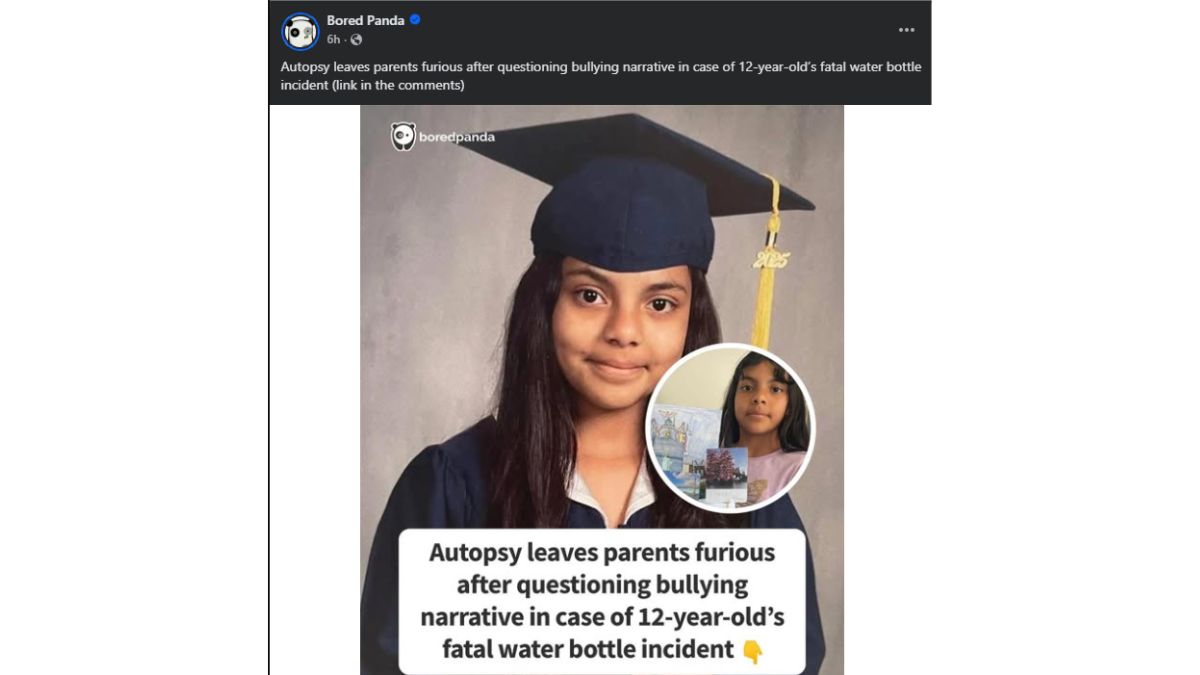
A medical ruling released this week has thrown one of Los Angeles’s most heartbreaking school incidents into fresh controversy, leaving the family of 12-year-old Khimberly Zavaleta furious and the public deeply divided over what truly caused her death.
Khimberly was a sixth-grade student at Reseda Charter High School when, on February 17, she stepped into a hallway confrontation to defend her older sister from a group of students.
During that altercation, another 12-year-old student threw a metal water bottle that struck her in the back of the head.
She complained of severe headaches afterward and was taken to the emergency room, but was discharged the same day after being assessed as stable.
Four days later, her condition took a dramatic turn for the worse. She collapsed, was rushed back to the hospital, and was found to have suffered a serious brain hemorrhage.
Doctors at UCLA Mattel Children’s Hospital placed her in an induced coma and performed emergency brain surgery in an effort to save her life. She died on February 25 when her heart gave out.
The case drew national attention. In April, the LAPD arrested another juvenile on suspicion of murder, though the identity of the suspect was withheld, given that both children were minors.
The family filed a civil lawsuit against the Los Angeles Unified School District, accusing administrators of failing to protect their daughter despite prior reports of bullying on campus.
Then came the autopsy report. On May 19, the Los Angeles County Medical Examiner officially ruled that Khimberly died from a spontaneously ruptured cerebellar arteriovenous malformation, a condition she had from birth, where fragile, tangled blood vessels in the brain are prone to rupturing.
Her manner of death was classified as natural, with no direct link drawn between the blow to her head and the fatal rupture.
The family and their attorney, Robert Glassman, pushed back immediately. He stated that before the incident, Khimberly had shown no symptoms and no warning signs that her condition posed any danger.
She was struck in the head, developed severe head pain almost immediately, and died within days. In his view, the timing speaks for itself, and the civil case against the school district will continue regardless of the autopsy findings.
The public reaction online reflected a widespread skepticism toward the ruling. Logan Hollows, whose partner also lives with an AVM, wrote: “I’d be willing to bet her bleeding wasn’t spontaneous but rather a slow rupture caused by the impact, which would explain the severe headache days before she passed.
Sudden and severe headaches are ALWAYS a potential brain hemorrhage unless ruled out. I’d also be going after the hospital for medical malpractice.”
Ditya Ditz asked the question that many were thinking:
“Was it established that even without the trauma from the water bottle, the spontaneous rupture would still have happened that same day and at that same time?”
Krystal Mac-Smith pointed to a legal argument the family’s lawyers may well pursue:
“I hope they look into the Thin Skull Rule. It means a defendant cannot argue that a normal person would not have been injured. Harm is harm.”
Cassie Trudel kept it simple:
“The bully is guilty. The people who run the school need to face penalties too.”
The criminal case now hinges on whether prosecutors can connect the blow to the rupture. The family says the answer is obvious.