

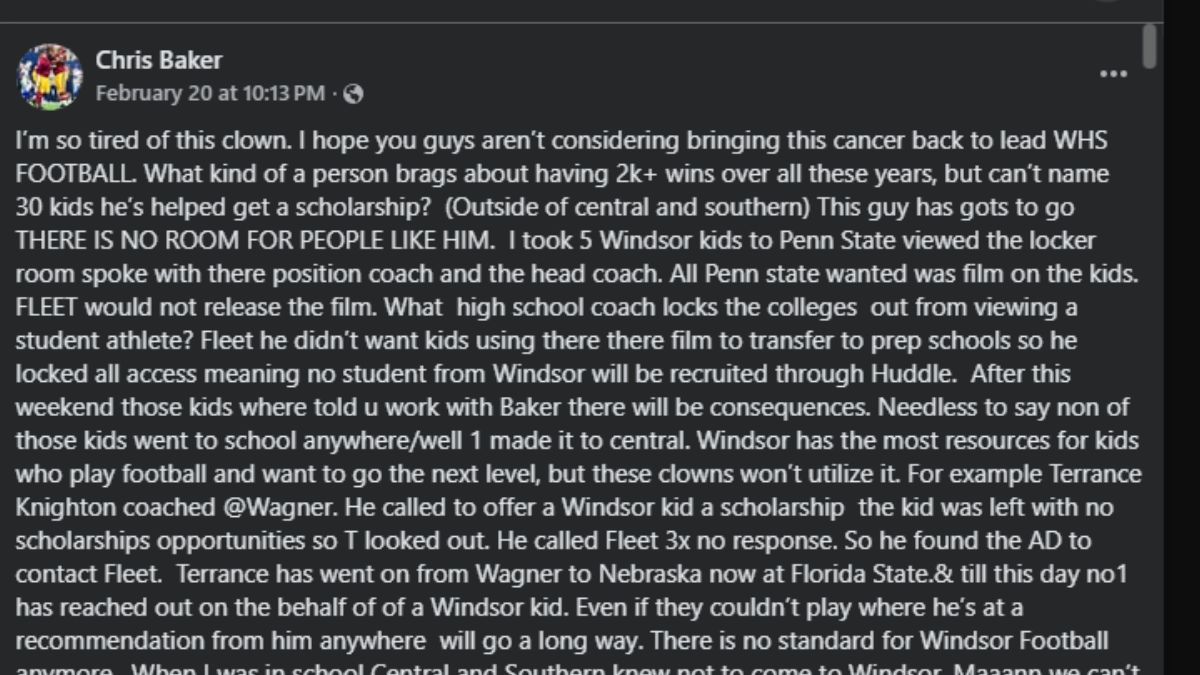
A heated online dispute has emerged surrounding the football program at Windsor High School Football after community member Chris Baker publicly posted allegations criticizing the program’s leadership and athlete development philosophy.
The discussion, widely shared across social media, centers on claims that athlete highlight film access was restricted, college recruitment communication was ignored, and student scholarship opportunities may have been lost as a result.
Baker’s post repeatedly emphasized the keyword phrase “Ignored Calls from Penn State & Terrance Knighton,” asserting that outreach from college-level programs was not properly followed up.
According to the post, films hosted on recruiting platforms were allegedly locked or not released to college scouts, which some parents and community members believe limited exposure for Windsor student-athletes hoping to compete at the collegiate level.
Modern high school football recruiting often depends heavily on digital scouting tools, where college programs review highlight reels before initiating contact with prospects.
Critics argue that limiting access to such film could reduce chances for athletes to be noticed by larger programs, while supporters of school administration maintain that student data protection, policy compliance, or internal athletic strategy sometimes requires controlled distribution of athlete media.
The controversy also referenced alleged communication attempts from Terrance Knighton, a former NFL player who transitioned into coaching roles within college football development programs.
Baker claimed that calls connected to scholarship opportunities were not properly returned or acted upon. Knighton’s reputation as a defensive coaching professional and player development figure has made the allegation particularly sensitive among parents who believe external college relationships should be actively maintained by high school programs.
Leadership at the football program has been defended by supporters who credit Rob Fleeting with restoring competitive performance and championship success.
Fans of the program argue that winning records and team discipline demonstrate effective coaching leadership. Several community voices stated that high school coaches are not legally required to secure scholarships for players, noting that college recruitment ultimately depends on college program evaluations, academic eligibility, and individual athlete initiative.
At the same time, critics argue that high school football should function as a bridge between secondary education and higher learning rather than focusing solely on game performance.
Some parents expressed concern that student athletes at Windsor may not have consistent communication with college programs or may lack circulating highlight material that could attract scouting attention.
Comments appearing online suggested that some juniors and seniors on the roster may not currently have active recruitment conversations, although these claims were not independently verified.
Public reaction to Baker’s post became sharply divided. Supporters applauded him for speaking openly about what they perceive as structural problems affecting athlete mobility.
Several commenters wrote that film access should not be restricted from colleges and that high school sports should prioritize student advancement beyond the playing field.
Others defended the coaching staff and program leadership, arguing that the football team’s success helped bring a winning culture back to the school and that social media criticism of coaches can be unfair without direct administrative dialogue.
One commenter stated that coaching staff members are not responsible for guaranteeing college scholarships and emphasized that parents must also participate in recruitment outreach, contacting colleges, attending camps, and helping build athlete profiles.
Another community member suggested forming organized alumni or booster-style support systems to assist athletes with exposure, suggesting that individual criticism alone may not produce structural change.
Some posts referenced experiences from other schools, claiming similar issues existed elsewhere, though these stories were not confirmed.
The conversation also reflects a broader national debate about youth sports development. High school football programs across the United States face increasing pressure to balance competition, discipline, and player development with academic and career advancement.
Scholarship competition has grown significantly, and even highly talented athletes may struggle to secure Division I opportunities because of roster limits, academic requirements, and scouting saturation.
Many observers argue that successful programs often maintain strong communication networks with college coaches, scouting platforms, and athletic mentorship organizations.
Social media comments surrounding the controversy show strong emotional responses. Some users believe the program should do more to promote student scholarship pathways, while others defend coaching leadership and highlight championship achievements.
Statements from parents and alumni indicate frustration about long-term athlete outcomes, but also recognition that recruitment success depends on multiple stakeholders, including athletes themselves, families, school staff, and college programs.
Supporters of Baker’s viewpoint continue to call for greater transparency regarding film distribution and college outreach logs.
Critics counter that public accusations without administrative review can damage reputations and create community division.
Some residents have proposed organizing formal meetings between parents, athletes, alumni, and school administrators to discuss recruitment support structures rather than relying solely on online debate.
The emotional intensity of the discussion also reflects the community’s deep investment in youth football development.
For many families, high school sports represent not just athletic competition but also an educational pathway. Parents want their children to have opportunities to earn a college education through athletic performance, while coaches are often expected to manage team success, discipline, and player growth simultaneously.
As the dispute continues, questions remain about communication transparency, recruitment exposure management, and long-term athlete development strategy within the Windsor football system.
Whether the controversy leads to policy review, program reform, or further community debate is still uncertain. What remains clear is that the keyword “Ignored Calls from Penn State & Terrance Knighton” has become symbolic of a larger conversation about responsibility in youth athletics, balancing winning culture with genuine opportunity creation for student athletes.
For now, the Windsor community watches closely as voices on both sides call for either accountability or unity, hoping that future discussions will focus on helping young players move closer to academic and athletic success beyond high school football.







Leave a Reply