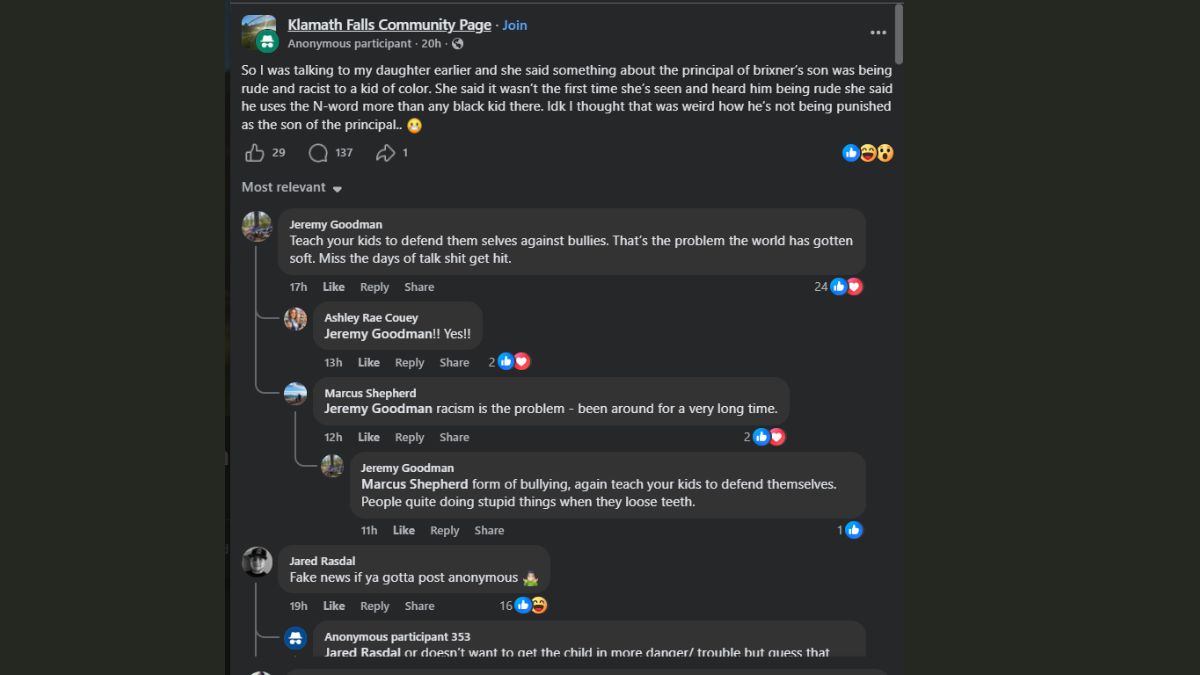
An anonymous post shared on a local Klamath Falls community Facebook page has sparked widespread discussion and strong disagreement among residents, parents, and commenters.
The post claims that a student, identified by the poster as the son of a school principal at Brixner, has allegedly been involved in repeated incidents of rude and racist behavior toward other students.
The writer also suggested that the behavior had been seen and reported multiple times, but was not being addressed appropriately.
The post quickly drew attention and triggered a wave of responses from community members, many of whom questioned the credibility of anonymous accusations being made on social media.
So I was talking to my daughter earlier and she said something about the principal of brixner’s son was being rude and racist to a kid of color. She said it wasn’t the first time she’s seen and heard him being rude she said he uses the N-word more than any black kid there. Idk I thought that was weird how he’s not being punished as the son of the principal..
Anonymous Participant
Some commenters expressed frustration over the lack of verified information and argued that such serious claims should be handled directly through school officials rather than public platforms.
Others, however, said anonymity may be necessary to protect students and families from retaliation or further harm.
Debate Over Accountability and Social Media Claims
The conversation rapidly shifted beyond the original allegation and turned into a broader debate about racism, school discipline, and fairness in how complaints are handled.
Some users defended the importance of calling out inappropriate behavior when it is witnessed, while others dismissed the claims as unverified or exaggerated.
Several commenters emphasized that schools should investigate concerns seriously regardless of how they are reported, while others accused the post of potentially damaging reputations without evidence.
The discussion also revealed deep divisions in opinion about race-related issues, student behavior, and what constitutes acceptable language among teenagers.
One group of users insisted that the situation, if true, reflects a failure in school accountability and raises concerns about whether students connected to staff receive different treatment.
Another group pushed back strongly, arguing that social media is not the proper place to accuse minors or school employees without formal complaints or proof.
Comments and Community Reaction
The thread included a wide range of reactions, from supportive messages to heated disagreements.
One commenter wrote that bullying should be addressed by teaching children to defend themselves, while another responded that racism should not be dismissed as simple bullying.
Marcus Shepherd form of bullying, again teach your kids to defend themselves. People quite doing stupid things when they loose teeth.
Jeremy Goodman
Another user questioned the reliability of the original post, stating that anonymous claims cannot automatically be treated as fact.
In contrast, some participants argued that anonymity is often used when individuals fear backlash or escalation, especially in school-related matters.
A few commenters urged parents to communicate directly with school administrators instead of engaging in online arguments.
One person noted that if there are genuine concerns, the appropriate step is to file a formal complaint rather than posting allegations publicly.
Commenter Perspective
Among the many responses, one commenter, identified as “Julie Anne,” shared a longer reflection on her own experience as a teacher.
CleverRhino3965 Take clear photos of the assignments before they turn them in and keep all graded papers and tests that are returned so you have some evidence. And have the students talk to the counselors about all of this. Often, they’re more helpful.
Julie Anne
When I was teaching 12th grade English in another state, one of my students told me that the 10th grade English teacher was demeaning her brother, calling him stupid and writing insults on his papers. He was! Things like, “you will never succeed,” “you’re hopeless,” etc. I was horrified. The poor kid had stopped trying. I told her to have their mother schedule an appointment with the principal and I would speak with the counselor and show her the papers. I wish the teacher was fired but he was a football coach so you know how that goes. But the student was moved and did pass.
She described past situations where students felt discouraged by classroom treatment and stressed the importance of documentation, communication with school counselors, and parent involvement.
Her comment shifted the tone briefly toward problem-solving and student support rather than confrontation.
Despite these attempts at constructive discussion, the thread continued to circulate between disagreement, defense, and criticism of how the situation was being handled online.
Some participants called for calm and due process, while others continued pressing for names and accountability.
As of now, the situation remains based solely on an unverified anonymous post, with no official confirmation from the school district.
The discussion, however, highlights ongoing tensions in how communities navigate sensitive allegations in the age of social media, where public opinion often forms long before facts are established.