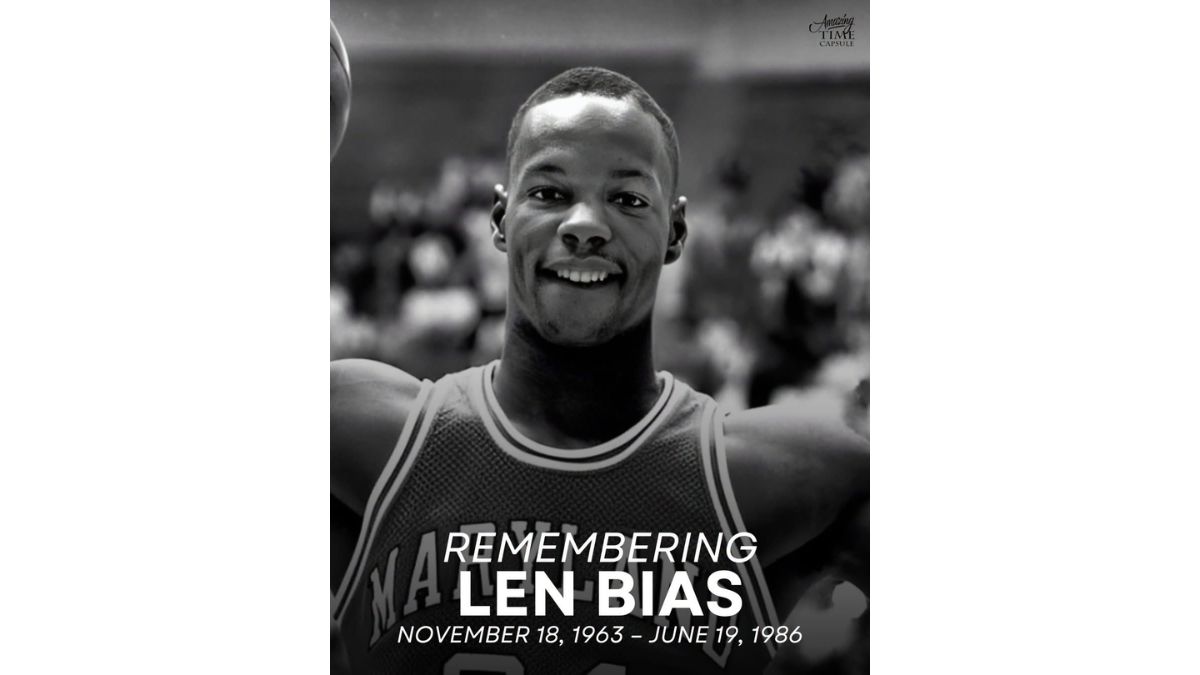
Forty years ago this June, Len Bias died at the age of 22, just two days after the Boston Celtics selected him as the second overall pick in the 1986 NBA Draft. The death of the Maryland Terrapins star remains one of the most haunting “what if” stories in American sports history, a moment that reshaped not only basketball but national drug policy for decades to come.
Born Leonard Kevin Bias on November 18, 1963, in Landover, Maryland, he grew up in Prince George’s County and attended Northwestern High School before enrolling at the University of Maryland.
Over four seasons with the Terrapins, Bias transformed from a raw freshman into a consensus first-team All-American, twice earning ACC Player of the Year honors.
His senior year included a legendary overtime performance against top-ranked North Carolina, where he scored 35 points and cemented his place among the most electrifying college players of his era.
Scouts compared his explosiveness and scoring instincts to Michael Jordan, and by draft night, the Celtics viewed him as the cornerstone of their next championship dynasty.
A Promising Future Cut Short
On June 17, 1986, the Celtics chose Bias with the pick they had acquired in a trade with the Seattle SuperSonics. He traveled to Boston for a signing ceremony and discussed a multimillion-dollar endorsement deal with Reebok.
Two days later, back on the University of Maryland campus, Bias spent the early morning hours with friends and teammates, including Brian Tribble, using cocaine in his dormitory suite.
He suffered a seizure and went into cardiac arrest. Despite emergency efforts, he was pronounced dead later that morning at Leland Memorial Hospital. Toxicology reports showed no alcohol or other drugs in his system, only powerful, uncut cocaine that proved fatal due to a cardiac arrhythmia.
His death triggered shockwaves across the country. More than 11,000 people attended his memorial at Cole Field House, and within months, Congress passed the Anti-Drug Abuse Act of 1986, signed by President Ronald Reagan.
The legislation became known as the “Len Bias Law” and introduced harsh mandatory minimum sentences, including the controversial 100-to-1 sentencing disparity between crack and powder cocaine offenses, a policy many historians say disproportionately targeted Black communities for years afterward.
Beyond the Symbol, the Person
While Bias became a cautionary symbol in America’s war on drugs, those who knew him insist his story is far richer than the tragedy that ended it. Friends and former classmates remember a playful, faith-driven young man who never let fame change his warmth toward others.
ESPN broadcaster Scott Van Pelt, who attended Maryland at the same time, described Bias as larger than life yet deeply human, someone who acknowledged everyone around him with genuine kindness.
The Bias family endured further heartbreak when his younger brother, Jay, was murdered in 1990. Their mother, Dr. Lonise Bias, became a prominent anti-drug advocate before her death earlier this year, while their father became a voice for gun control reform.
Today, scholars and former teammates argue that Bias deserves to be remembered not only as a drug-related headline but as a gifted athlete and a young man on the verge of adulthood, full of promise, doubt, and humanity.
As one friend put it, what is often lost is not simply the question of what might have been, but the truth of who Len Bias actually was.