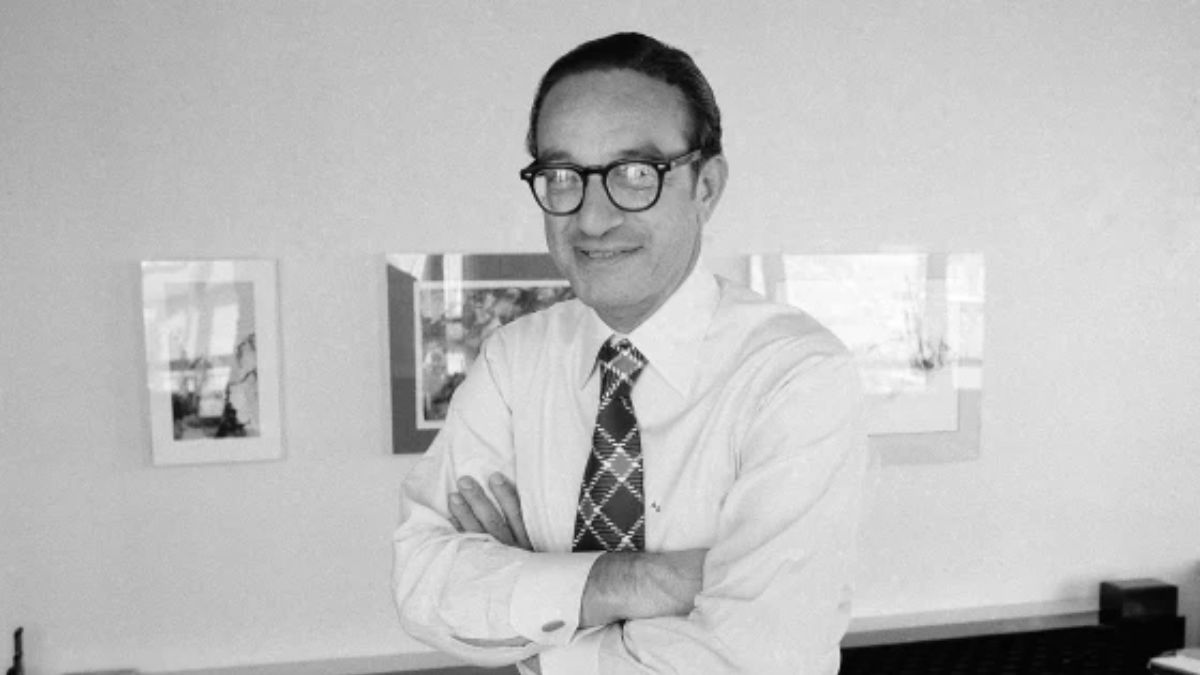
Alan Greenspan, the economist who guided American monetary policy through five terms as chairman of the Federal Reserve, died Monday morning at his home. He was 100 years old.
His wife, longtime NBC News correspondent Andrea Mitchell, confirmed his death in a statement, saying he passed away from complications related to Parkinson’s disease.
Mitchell, who was married to Greenspan for 29 years, described him as a man who helped guide the nation’s economy across decades and administrations from both political parties, while remaining willing to admit when he had gotten things wrong.
From Jazz Clubs to Economics
Greenspan was born in March 1926 in the Washington Heights section of New York City. As a young man, he displayed a talent for music and mathematics, attending Juilliard and performing jazz saxophone and clarinet before turning his focus to economics.
He earned both a bachelor’s and a master’s degree from New York University and later pursued doctoral studies at Columbia, where he studied under economist Arthur Burns.
During the early 1950s, Greenspan grew close to novelist and philosopher Ayn Rand, whose ideas about individualism and free markets left a lasting mark on his economic thinking. He later credited her with shaping much of his worldview.
His path into government began with informal advisory work for Richard Nixon and continued under President Gerald Ford, for whom he chaired the Council of Economic Advisers.
After a stint back in the private sector during the Carter years, Greenspan returned to Washington when President Ronald Reagan nominated him to lead the Federal Reserve in 1987, succeeding Paul Volcker.
Steering the Economy Through Boom and Crisis
Just months into his tenure, Greenspan faced his first major test when the stock market crashed on October 19, 1987, an event remembered as Black Monday.
His quick action to keep markets stable earned him early credibility and helped establish what became known as the practice of the Fed stepping in to support markets during periods of turmoil.
Greenspan went on to lead the central bank through one of the longest periods of economic growth in American history, spanning the early 1990s through the start of the 2000s.
That stretch encompassed the rise of the internet economy, the bursting of the dot-com bubble, and the aftermath of the September 11 terrorist attacks.
His steady hand and folksy public image earned him nicknames such as “the maestro,” and his economic commentary, including a famous warning about “irrational exuberance” in the stock market, became part of the cultural lexicon.
His legacy, however, was complicated by the financial crisis that struck in 2007 and 2008.
Critics, including the bipartisan Financial Crisis Inquiry Commission, later concluded that Greenspan’s support for deregulation and his reluctance to rein in risky mortgage lending practices contributed to conditions that led to the collapse.
After retiring from the Fed in January 2006, Greenspan continued to write and consult, publishing a memoir reflecting on his time in public service and his relationships with the presidents he served.
He received numerous honors over his career, including the Presidential Medal of Freedom from President George W. Bush in 2005, the French Legion of Honor, and an honorary knighthood from Queen Elizabeth II.
Greenspan is survived by his wife, Andrea Mitchell.